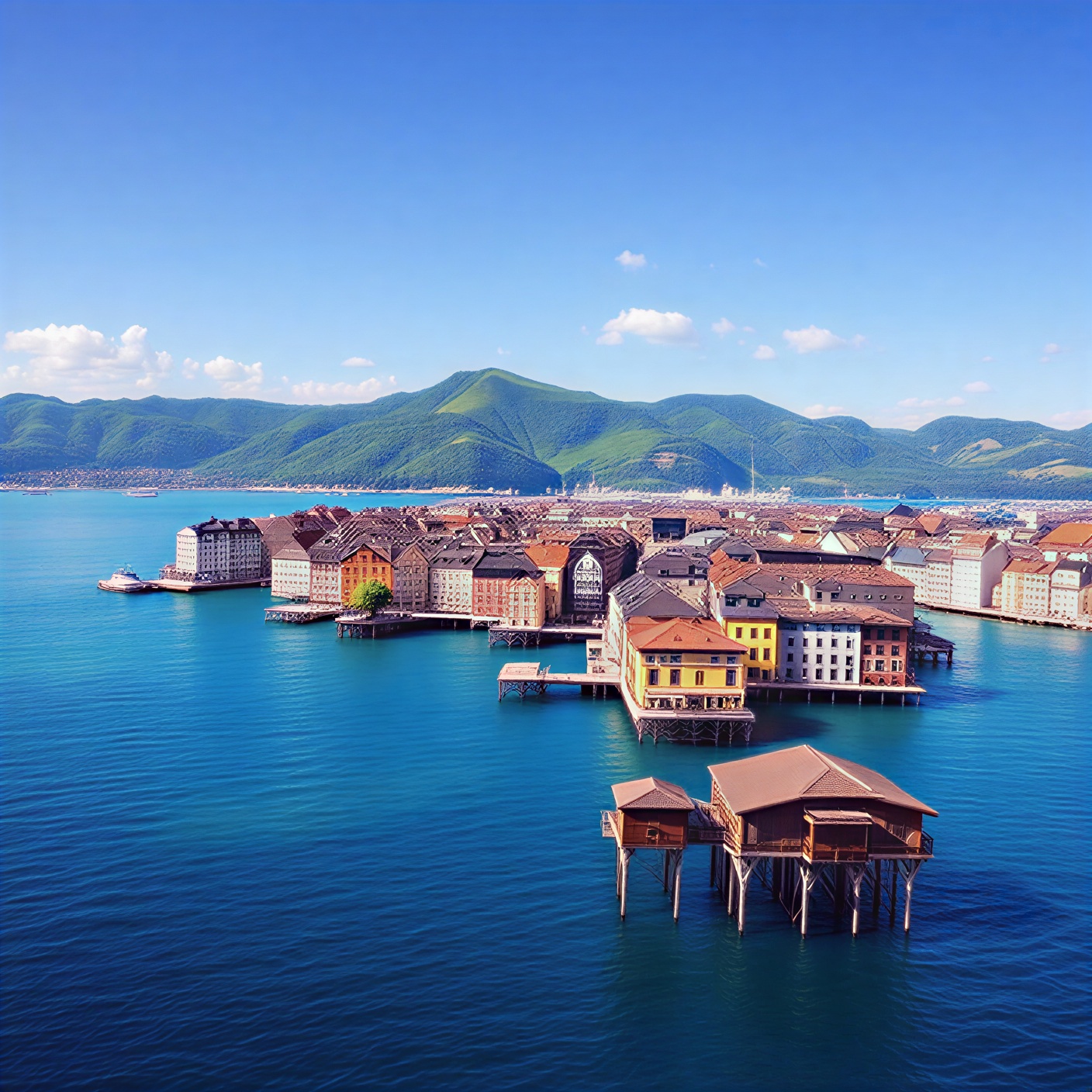
Basel, Switzerland, in the year 2125, an ultramarine paradise on stilts in the Sea of Switzerland. Dystopia has never been this good
Time and place (let’s call it space) play a big role in the novel Drifting on the Edge. The reason is simple. I’d just read Stephen Hawking’s A Brief History of Time. But I had also been reading a very different book — one about refugees crossing the border near where I live on the Swiss frontier outside Basel. In eyewitness interviews, people talked about how WWII changed their lives on the border, how refugees (many from Eastern Europe) crossed each day to flee the Nazi regime, how the border closed, and how eventually it was sealed by a barbed wire fence.
The fence ran from the Rhine downstream and upstream from Basel, cutting through fields and dense forest along the way. One small section was left open, though. It’s called Eiserne Hand (Iron Hand), and it’s less a hand than a finger of Switzerland that pokes into Germany’s fleshy rump deep in the Southern Black Forest.
The Nazis wanted to put their fence across its narrow opening, because anything else would have meant fencing off the entire perimeter of about 4km. The Swiss thought they might not get it back after the war. So, heavily guarded, this sliver of land remained unfenced. As I write this, it is about 100 meters behind me.
Other books influenced the novel too. I was probably reading some pulp fiction at the time, because I’m decidedly “carefree” about distinctions between “high” and “low” literature.
These three things came together in Drifting – Hawking’s book on time, another book on the region during WWII, and pulp fiction.
IT’S ABOUT TIME
Space was not a big problem in the book. It’s set on the border of France, Germany and Switzerland — around that imaginary point in the middle of the Rhine river just downstream from Basel.
Time was a problem, though, because I’d set the novel in the present, past and future. The characters aged only nominally in the future, but otherwise they stayed the same age, much as they do in Ettore Scola’s 1983 film Le Bal, which tells the story of a ballroom over five decades.
So far, so good. But time in a block universe, which is how most physicists see time, is counter-intuitive for readers, who are used to a beginning, middle and an end arranged in a linear timeline. Even when plots in novels jump back in time or skip to the future, they’re still pretty much linear. There are novels with cyclical time. One is Gabriel García Márquez’ 100 Years of Solitude. And, of course, different cultures see time in different ways.
But can you really spin your characters back to WWII, put them on the balcony of a fine hotel and have Joe Jackson’s Steppin’ Out (1982) playing over loudspeakers?
You can if everything exists everywhere all at once.
NOVELISTIC BLOCK UNIVERSE – A BUMMER FOR EVERYONE
At the end of this blog you can find a video from Sabine Hossenfelder, a physicist, who explains time and space in a block universe.
The essence of the block universe is that past, present and future all exist together simultaneously without one being “more real” than another. All moments in time are equally real. Events don’t happen in a flow from past to future. What changes is not time itself, but our experience of it. And that’s the bummer for novel readers looking for linear cause and effect. They want Action A in Chapter 1 to trigger Consequence B in Chapter 5. Disrupt that flow sometimes, or suggest that it’s all happening simultaneously, and the reader might start to question where they are in the world, when, and perhaps even why.
Novels Have Imaginary Time
Novels have always had their own imagined sense of time that, for a while at least, we accept as totally believable and real by suspending our disbelief. We get on with enjoying a ripping yarn until we reach THE END. Then, this imagined time ceases and real-world time kicks in again. At least, we hope it does.
DRIFTING IS PROFANE
So much for time. Drifting is also profane in other ways.
Drifting disregards the distinction between high and low literature. It’s as if you put pulp-fiction author Kinky Friedman (RIP our crime-solving, New-York-based Jewish Texan cowboy) in the same shoebox as Shakespeare (Shakespeare is quoted quite a lot in the book) and tell the reader that everything exists simultaneously and that their perspectives are equally valid. Isn’t that what a theoretical physicist might say too?
And it’s not such a far-flung idea. Shakespeare was a popular writer in his age. Both Kinky and the Bard were masters of the crude joke, profane language and innuendo. Charles Bukowski was long considered low-brow smut and vulgar shock-artist. Today, we might study him alongside Hemingway. And as for dear old 14th-century Geoffrey Chaucer and his The Canterbury Tales, well, let’s not get into his medieval profanity. Meanwhile, in Italy, Boccaccio wrote The Decameron in 14th-century Florentine vernacular.
WHY SOME READERS FIND THIS MADDENING
Profanity can be a bit much for some readers. It always looks better much later, from a distance, and with the seal of approval in the literary canon. Close up, it’s a bit rough. Quite literally, Chaucer fart-joked his way into the literary canon.
But Shakespeare placed alongside a Jewish cowboy from Texas who thinks all cats are Republicans? You must be joking!
Yes, I am. Sort of.
Now the Video
In this video, Sabine explains time in the block universe. Does that explain why, in one chapter, two characters in Drifting watch a football match together at Basel’s football stadium and see much the same things happening but at different times?
Well, that might happen if they were moving at vastly different speeds or were separated by vast cosmic distances. They’re not. Sitting next to each other, the difference is only in nanoseconds and too miniscule for their brains to notice.
But their drinks were spiked with an unknown substance, so it’s not surprising that their nanoseconds become somewhat extended and warped.
DOES THE PAST STILL EXIST